Welcome to the website of research project ASLAN (Assisted Scoring of Laener Answers through Normalization).
Latest News
- February 2026: Project Website Released
- January 2026: First Project Meeting in Essen
Project Overview
Assessing student learning progress is a core task in education. Free-text questions play an important role in this process, as they require different competencies than multiple-choice formats. However, grading free-text answers is highly time-consuming due to their linguistic variability: even short answers often differ substantially from one another.
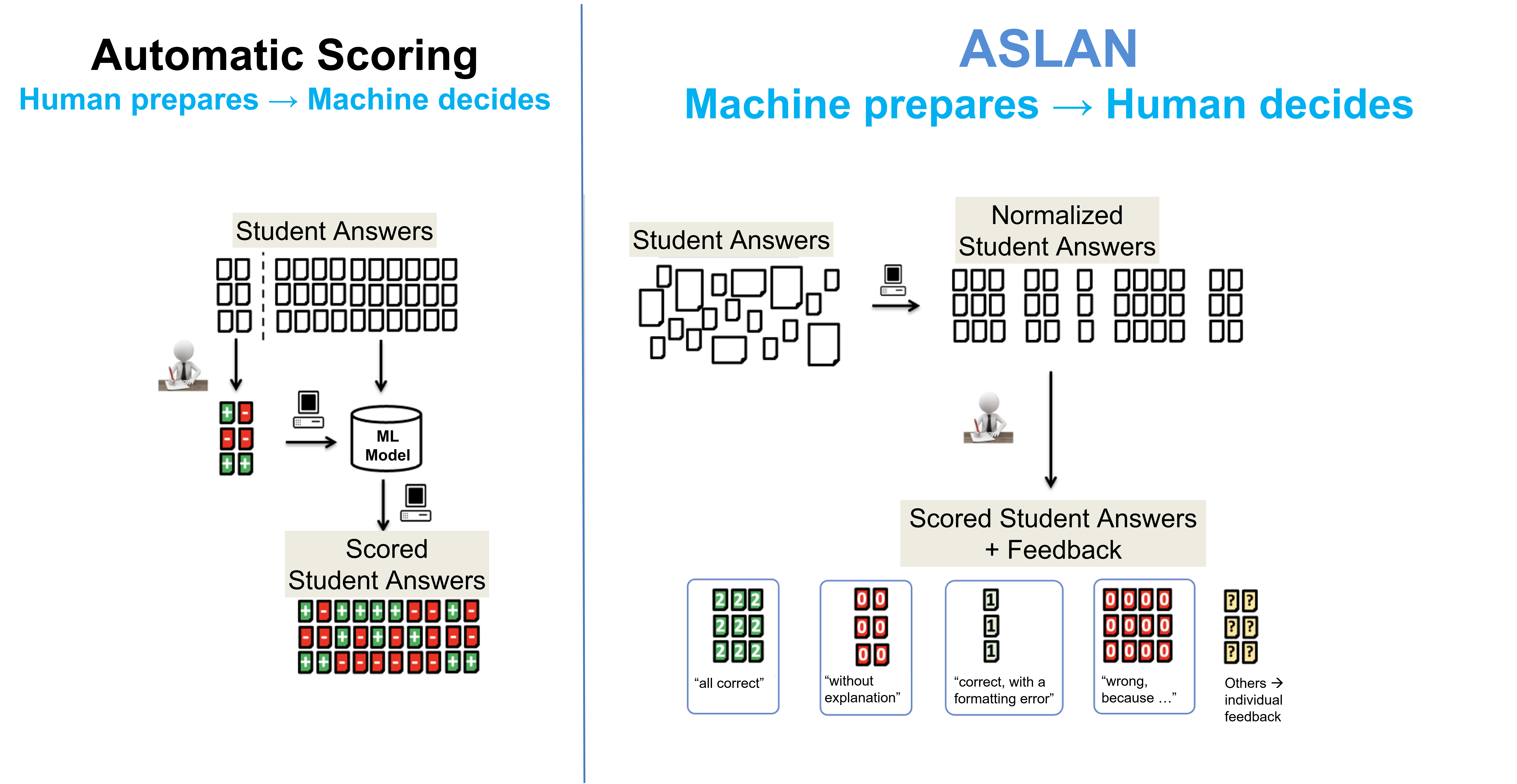
The ASLAN (“Assisted Scoring of Learner Answers through Normalization”) project supports teachers by reducing linguistic variance in learner answers through transparent linguistic normalization techniques. Equivalent answers are grouped and can be assessed or given feedback together, enabling efficient, explainable, and human-centered grading.
This approach allows feedback and grading rationales to be transparently applied to entire groups of similar answers. By making normalization steps explicit, ASLAN provides a form of explainability that is directly useful to teachers, avoiding many of the ethical, legal and acceptance issues associated with fully automated scoring systems.
Research objectives
The main objective is to investigate an alternative assessment model for free-text tasks based on supporting manual evaluation through text normalization, enabling fine-grained feedback. To achieve this, the project addresses several specific research objectives:
- Performance Analysis: Evaluate how the proposed approach influences the accuracy and time requirements of assessments compared to conventional human scoring on one hand and a fully automated scoring model on the other.
- Methodological Suitability: Investigate which existing text normalization approaches can be applied to learner responses, identifying where adaptations are necessary or where entirely new methods must be developed.
- Cross-Lingual Transfer: Explore how existing approaches developed for other languages (primarily English, e.g., the resolution of numerical expressions) can be effectively transferred to German.
- Process Optimization: Determine the role and impact of the sequence of normalization steps on the overall quality of the results.
- Bias and Robustness: Analyze which biases are introduced or amplified by the normalization process and assess the system's vulnerability to adversarial inputs.
Cooperation Partners

Funding information
Funded by the Deutsche Forschungsgemeinschaft (DFG, German Research Foundation) – Project number 563947383.
Contact
For inquiries, please contact: aslan@list.fernuni-hagen.de